Service 02 · Migrate
GIS Data Migration, Conversion & Automated Import/Export
Move Data Across Systems — Once or Every Night.
This is SEPM's core operational engine: high-volume transfer, translation and restructuring of spatial and tabular data across systems, formats and database structures. With SEPM X-Translator, SEPM X-Raster and dedicated database connectors, we run complex one-off migrations as well as fully automated, headless batch conversions.


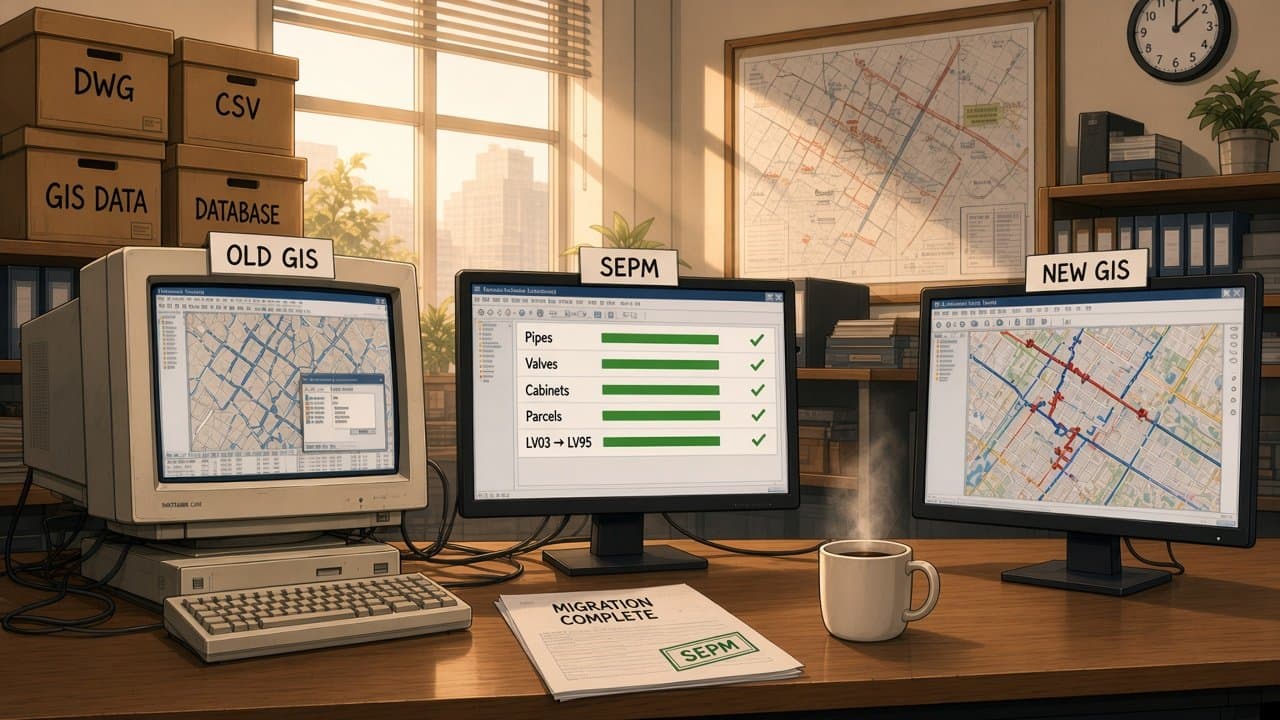


Decades of network data, stuck in the old system.
Moving it by hand takes months, and something always gets lost.
SEPM maps, converts and transfers it, automatically.
Every feature and attribute arrives intact, coordinates converted too.
Move your GIS data. Without rebuilding everything.
Scope
What We Move.
Four capabilities that combine into migration projects and recurring data exchanges.
Full-Scale System Migrations
Large transitions between legacy GIS platforms, CAD environments and database schemas — for example from Oracle/LIDS or VSE into modern Smallworld NIS architectures.
- Oracle
- LIDS
- VSE
- Smallworld NIS
Automated Batch Processing
Scheduled, server-based background jobs — via SEPM Simple GUI or command-line engine calls — that handle recurring data exchanges without user intervention.
- Headless
- CLI
- Cron
- SEPM Simple GUI
Coordinate Transformations
Reprojection across Swiss (LV03/CH1903 to LV95/CH1903+) and international (UTM, WGS84) reference systems as part of every transfer.
- LV03
- LV95
- WGS84
- UTM
Multi-Format Interoperability
Vector features, raster layers and attributes converted across CAD, GIS, web and specialised industry formats.
- DWG/DXF
- Shapefile
- GeoJSON
- PostGIS
- File Geodatabase
- KML/KMZ
- INTERLIS
- ISYBAU
- NEPLAN
Selected work
Migration in Practice.
01Electricity
BKW Energie AG · NIS AG
La Goule: from Oracle/LIDS to Smallworld NIS
Electrical distribution data — substations, cabinets, low-voltage lines and customer connections — had to move from legacy Oracle/LIDS databases into BKW's Smallworld NIS environment.
- Oracle/LIDS
- Smallworld NIS
- Magik
- Excel
What SEPM did
SEPM programmed customised extraction and translation routines from the Oracle source into NIS electricity entities.
- 1Schema mapping — Oracle source tables mapped to NIS electricity entities.
- 2Value enrichment — indirect foreign keys resolved into real values, such as fuse ratings instead of raw table keys.
- 3Spatial placement — orphaned objects such as generators without house connections assigned to the nearest connection box.
- 4Feeder integration — Excel feeder lists parsed by dedicated Magik routines to update cabinet circuit structures automatically.
Outcome
A complete legacy network moved into NIS with its structure intact.
02Gas · Public geodata
Swissgas
KML export pipeline for map.geo.admin.ch
High-pressure gas pipeline data had to be published from Smallworld GIS as web-compliant KML/KMZ on the Swiss national geoportal.
- KML/KMZ
- Excel
- map.geo.admin.ch
- pipeline segments
- 1,368+pipeline segments
- marker posts
- 12,650+marker posts
What SEPM did
SEPM configured an automated export and deployment pipeline on X-Translator.
- 1Consolidation — pipeline segments and marker posts from KML, KMZ and Excel merged into a Smallworld staging database.
- 2Filtering and styling — visibility and colour rules separating high-pressure pipelines from marker posts.
- 3Automated deployment — formatted KML exported and hosted for direct permalink integration into map.geo.admin.ch.
Outcome
Public geodata published straight from the operator's GIS.
03Multi-utility · Open source
SW Heidelberg · SW Kleve
Bidirectional Smallworld ↔ PostGIS exchange
Utilities wanted Smallworld data in PostGIS for web mapping in QGIS and spatial analytics — and PostGIS data back in Smallworld.
- PostGIS
- JDBC
- SRID 2056
- QGIS
What SEPM did
SEPM set up both directions of the exchange.
- 1Smallworld to PostGIS — buildings and network assets exported with auto-generated tables, GiST spatial indexes and LV95 (SRID 2056) geometry.
- 2Connection options — direct JDBC connections or headless SQL script generation for offline ingestion.
- 3PostGIS to Smallworld — multipolygons, lines and points mapped back into feature classes with topology preserved.
Outcome
Enterprise GIS and open-source analytics working from the same data.
Capabilities
The Engine Behind Every Transfer.
- Batch migration engine
- Technical approachHeadless command-line execution of x_translator via scripts or cron jobs
- Benefit to youTens of thousands of objects processed automatically, without UI overhead.
- Flexible value mapping
- Technical approachConfigurable attribute lookup tables in Excel or Magik
- Benefit to youDomain values standardised automatically — “Schacht 1x1m unterflur” becomes GIS code “1/1”.
- Raster data processing
- Technical approachSEPM X-Raster for TIFF, PNG and ECW
- Benefit to youGeoreferenced raster backgrounds moved alongside vector features.
- Differential operations
- Technical approachInsert, update (via connection ID) and delete modes
- Benefit to youFull overwrites or targeted updates to changed attributes only.